Get instant, evidence-based guidance to assess your cat’s labor progression. Veterinary AI helps you distinguish normal delivery from complications and prepare for emergency veterinary care.
Feline labor occurs in three stages: uterine contractions, active delivery of kittens, and expulsion of placentas. Normal delivery typically takes 2-6 hours. Recognizing normal progression helps distinguish healthy labor from complications like dystocia.
While most cats deliver without intervention, complications can arise, including uterine inertia, obstructed labor, or fetal distress. Objective triage helps you monitor normal progression and recognize warning signs requiring immediate veterinary intervention.
Labor progresses through three distinct stages, listed from early signs to active delivery.
Stage 1 — Uterine Contractions (12-36 hours)
Restlessness, nesting, vocalization, decreased appetite, and seeking seclusion in a quiet, warm area.
Stage 1 — Temperature Drop (12-24 hours before)
Rectal temperature drops below 100°F (37.8°C) approximately 12-24 hours before active labor begins.
Stage 2 — Active Delivery
Strong visible contractions; delivery of kittens (typically 15-60 minutes between births).
Stage 2 — Rupture of Membranes
Clear fluid is released with each kitten; dark green discharge indicates placental separation requiring attention.
Stage 3 — Placental Expulsion
Placentas are delivered after each kitten; queen may eat them (normal behavior). Count placentas to ensure none are retained.
Post-Labor — Nursing and Bonding
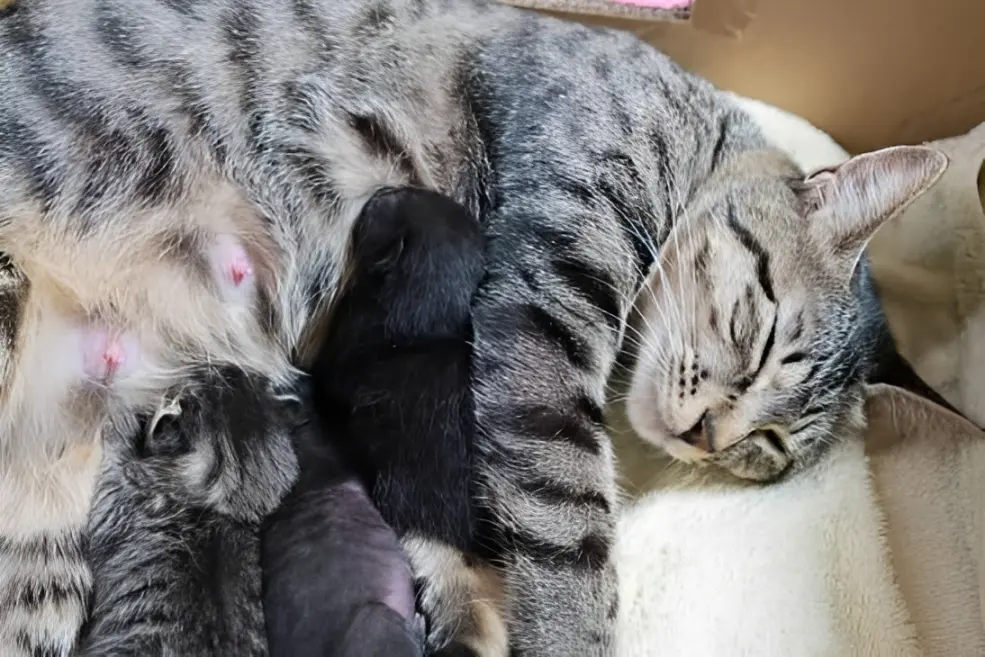
Kittens should nurse within 2 hours; queen rests and bonds with her litter. Monitor for adequate milk supply and kitten activity.
✦ This list represents common stages and signs of feline labor but does not constitute a complete diagnosis. Normal labor typically lasts 2-6 hours for active delivery. A veterinary examination is essential if labor progresses abnormally, if there is prolonged straining (>30 minutes without a kitten), or if signs of distress develop. Veterinary AI provides real-time clinical triage tailored to feline labor signs, helping you distinguish between normal delivery and complications requiring prompt veterinary attention with clarity and confidence.
Non-invasive, medically safe measures to support your cat during labor and monitor for normal progression
Monitor Contraction Frequency
Note interval between contractions; strong, regular contractions should produce a kitten within 15-30 minutes
Observe Delivery Progress
Record time between kittens; if >60 minutes pass without a kitten, contact your veterinarian
Check for Placental Passage
Count placentas delivered; each kitten should have one placenta; retained placenta can cause infection
Keep the Area Quiet and Warm
Reduce stress and maintain warmth; provide a secluded, comfortable nesting area away from noise and traffic
Monitor Queen's Condition
Watch for signs of exhaustion, excessive bleeding, or distress; ensure she has access to water
Do NOT Intervene
Do NOT pull kittens, cut cords, or manually assist unless instructed by a veterinarian
⚠ These guidelines are for monitoring purposes only. Do not delay veterinary care if labor complications arise. Seek immediate veterinary attention for prolonged labor (>30 minutes without a kitten), retained kittens, dark green discharge before labor, or signs of distress. Do not attempt to intervene manually without professional guidance.
TESTIMONIALS
Timely, clinically-grounded support for every stage of your cat's labor assessment
When your cat shows signs of labor and you cannot determine whether it signals normal delivery or a complication requiring immediate veterinary intervention.
If labor stalls (>30 minutes without a kitten), contractions weaken, or your cat shows signs of distress, exhaustion, or dark green discharge — these may indicate complications requiring urgent veterinary care.
When you need clinically grounded, exportable guidance to maximize the effectiveness of your emergency veterinary visit; including a structured clinical summary documenting labor progression, kitten count, and signs of distress.
💡 Always trust your instincts. If you are concerned about your cat's labor, Veterinary AI provides immediate, evidence-based assessment; but never delays seeking emergency care when your cat shows prolonged straining (>30 minutes without a kitten), dark green discharge before labor, weak contractions, or signs of systemic illness. Labor complications are life-threatening emergencies. Do not attempt to intervene manually without professional guidance.
Labor complications can be life-threatening. These warning signs require prompt veterinary attention, supported by Veterinary AI's core tools when your cat shows labor signs and related complications.
Prolonged straining >30 minutes without delivering a kitten is flagged as a critical emergency; this may indicate uterine inertia or obstructed labor requiring immediate veterinary intervention.
Dark green or bloody vaginal discharge before any kitten is delivered signals placental separation; this is a medical emergency requiring immediate veterinary evaluation.
Systemic signs (fever, lethargy, vomiting, collapse) requires organized data for your emergency vet; our report consolidates labor progression, kitten count, and clinical history for rapid evaluation.
Weak or absent contractions despite active labor (uterine inertia) triggers an alert; this may require emergency cesarean section or medical intervention.
Signs of eclampsia (milk fever): restlessness, panting, tremors, or seizures suggests hypocalcemia; this is a medical emergency requiring immediate calcium supplementation and veterinary care.
Prolonged gestation (>70 days) or persistent unproductive labor requires comprehensive data; our summary documents all observations to help your veterinarian expedite care and determine the need for intervention.
🚨 Any of these signs? Seek emergency care NOW.
Veterinary AI prepares a clinical summary for your emergency veterinarian while you prepare, but prompt emergency attention is essential for prolonged straining, dark green discharge, weak contractions, eclampsia, or signs of systemic illness. Labor complications are life-threatening emergencies. Do not attempt to intervene manually without professional guidance.
Flexible, cancel anytime
Best value for your pet
Just €7.58/month
Thanks for your interest in Veterinary AI. We'll notify you as soon as your AI consultation is ready. Check your email for confirmation.
More and more pet owners trust Veterinary AI for their pet's health. Get instant AI consultations, track medical records, set vaccine reminders, and access expert guidance — all from your phone. No waiting rooms, no appointments. Start now.
Everything you need to know about cat labor signs and how Veterinary AI can help. Can't find what you're looking for?
Start Labor Signs AssessmentSigns include restlessness, nesting, vocalization, decreased appetite, and a drop in rectal temperature below 100°F (37.8°C) 12-24 hours before labor.
Stage 1 (uterine contractions) lasts 12-36 hours. Stage 2 (active delivery) typically takes 2-6 hours, with 15-60 minutes between kittens.
Straining for >30 minutes without delivering a kitten is a medical emergency. Seek immediate veterinary care. Do NOT attempt to pull kittens yourself.
Signs include prolonged straining (>30 minutes), dark green vaginal discharge before labor, weak contractions, exhaustion, fever, or eclampsia signs (tremors, seizures).
No, do NOT intervene unless instructed by a veterinarian. Avoid pulling kittens, cutting cords, or manually assisting. Keep the area quiet and observe from a distance.